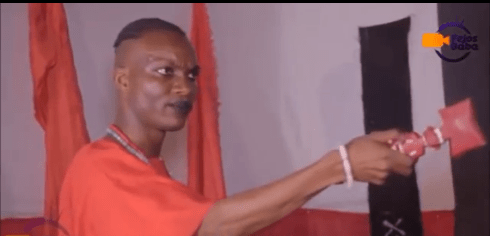
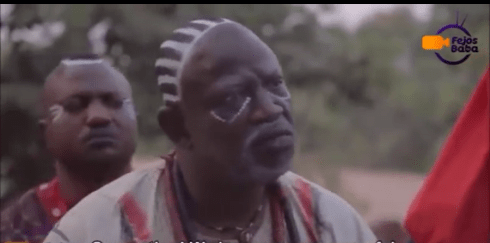
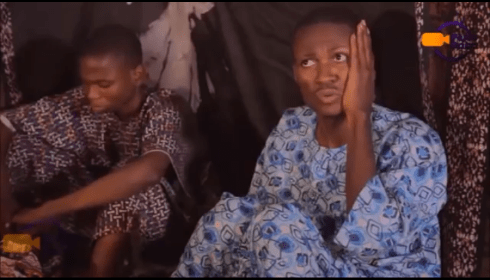
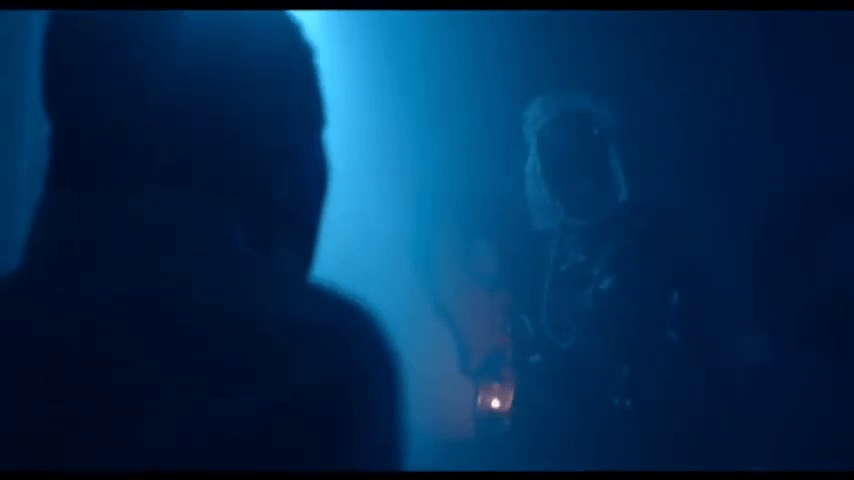
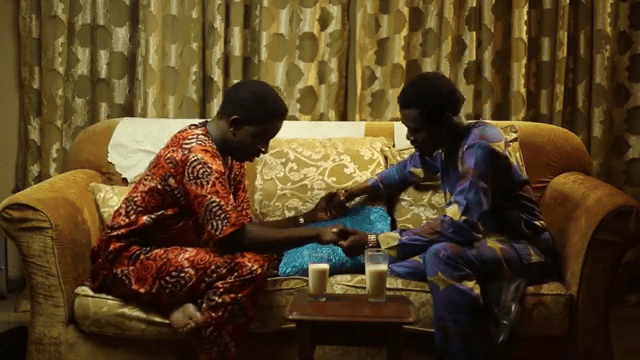
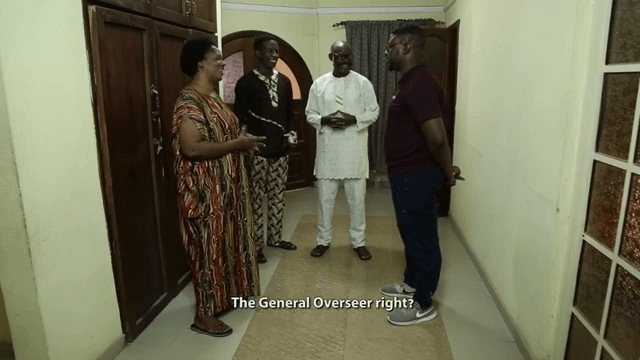
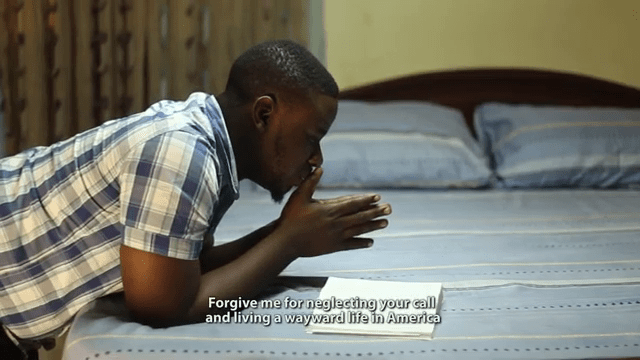
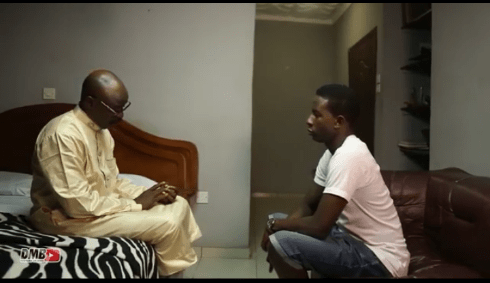
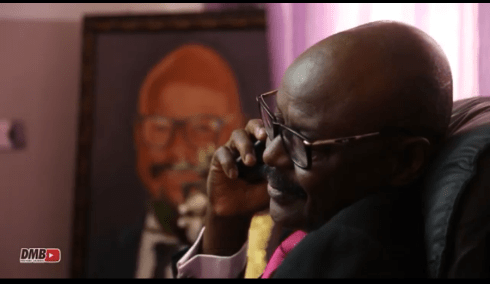
Something I have observed about many gospel and Christian films is that even after watching a couple of times, you’d still need to pray for more spiritual understanding so that they could impact our lives to the maximum. “Hacked” is one of such movies…
In with the new…
You’re welcome to the review of the short film “Hacked” from EVOM World Network. I’m beginning to fall in love with EVOM short films because they are creating a knack for innovation. Firstly, “Corked” marked the new introductory tune for the ministry name display, during the review of which I commended it but also expressed my thoughts on the need to accompany it with a modern-day animation (The link to that article https://witnessgospelreviews.movie.blog/2020/08/21/corked-review/). “Hacked” marks the start of that animation and it was beautiful to see the contemporary interpretation of the old animation; very well done.
Title page
The music in recent EVOM movies has had this distinct feel to it and it’s the same here. Tomisin and Feranmi Agboola should be commended for their industry in the Sound Effects and Music of these films. I believe there’s more and better to come from them. Similarly, the cinematography by Tomisin Agboola plays a vital role in the early stages of the story by showing, and not telling.
As I’ve said in previous reviews, the level of propriety shown by EVOM movies is remarkable and it’s seen in the design used for the film’s title, one connected with computer codes, similar to the one launched by “The Matrix” trilogy. This made me think though that the story would be about a certain cyber criminal called Pius; it wasn’t. It was something more, and something quite different. It’s sort of a mirror of one of the challenges of our lives in this age; we’re very, very, very busy. It’s relatable to us both physically and spiritually. No spoilers. So, watch it and you’ll get what I’m talking about.
The trailer poster picture
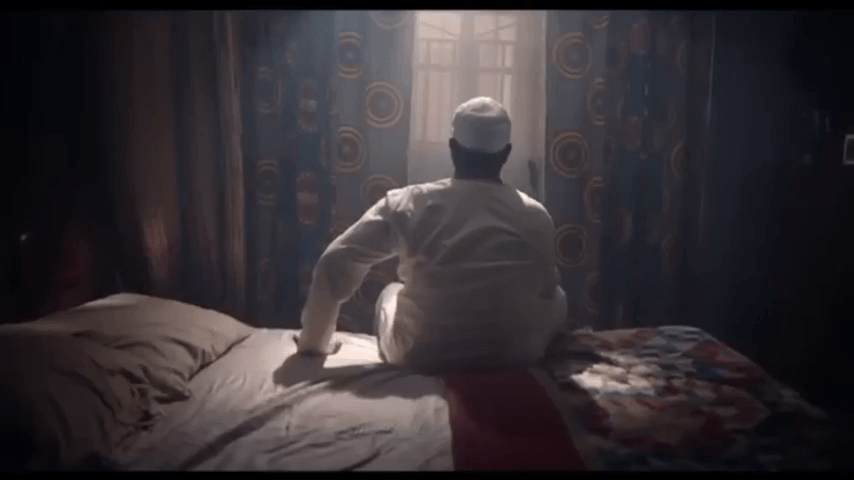
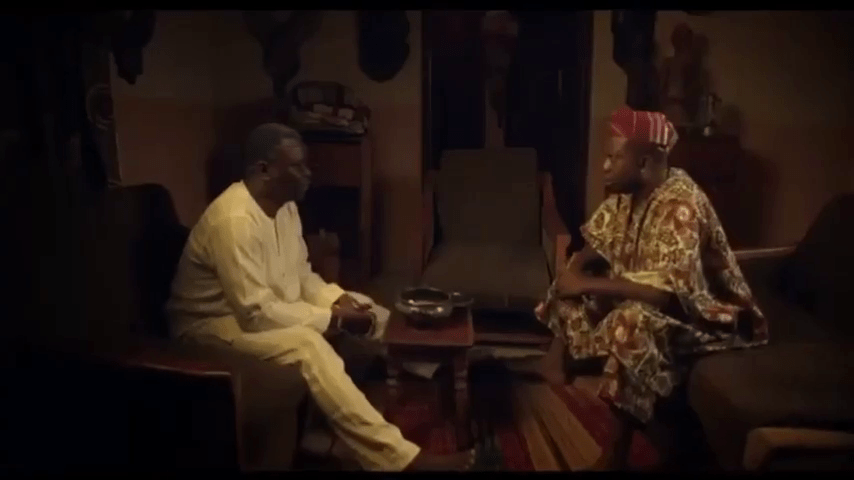
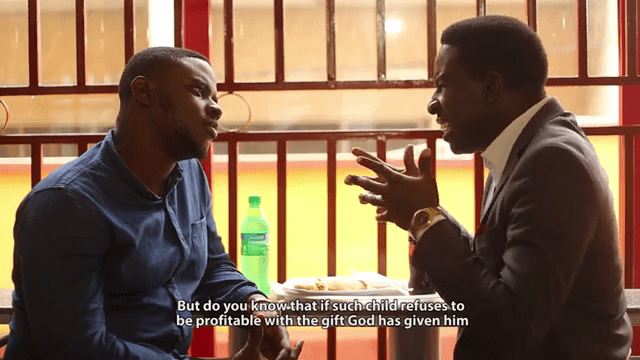
In any case, there’s this scene that brilliantly portrays what spiritual hacking entails. The only speaker in that scene is a preacher but he’s off-screen throughout while Pius is busy with something else; that was a succinct illustration of the literal state of Pius’ mind. In one ear, out the other. This affected not only his walk with God, but also his job. I still pray for better understanding of this movie, because I really feel it’s deep with realities that would help us in our relationship with God.
Hey folks! You’re welcome to the second edition of Fantalk for Abejoye Season 4. We have two poster pictures to look at,as well as giving you an update on its date of release. So, this will be a short one; let’s get right into it.
The poster above bears the tag “Ajibogun ya!” which was first spoken at the dramatic end of Season 2 Part 1 when the imprecations meant to bring Baba Abejoye back home didn’t work on him because he was surrounded by God’s hedge of fire, but bounced off him and touched Bamidele who had opened the door to the devil by living in deceit. At the end of the entire Season 2, a return to Ajibogun was mooted again when after Abejoye resolved the conflict between Dedun and her husband, they expressed plans to meet whenever Baba got back to Nigeria.
Interestingly, just halfway into Season 1, Baba was basically on his way back to Ajibogun, but the Pastor saved his blushes. This means that in the three seasons so far, the return to Ajibogun has been coming for a while, and in Season 4, we’ll get to know what’s so special about the Nigerian village called Ajibogun.
Baba Abejoye in a silhouette
The other poster really caught my attention because I noticed a similar motif in the trailer that I didn’t think much of before. Baba had his back turned in a certain shot as the camera zoomed in towards him. It then stopped and as Baba turned his face towards the audience; what we see is a dark profile where his face is virtually invisible. Interestingly, this scene might not even be in the movie but just serves as a teaser for it.
A dark profile of Baba
This is similar to this poster picture where Baba’s entire physical features are essentially in a silhouette. Why this dark theme? What does dark mean? Will the light of Christ in Baba go dim? Will he turn evil? Is he going to lose someone he loves? We’ll know soon enough.
Release dates
Abejoye Season 4 is coming to YouTube from December 20 to Jan 10, 2021, in guess what? 4 EPISODES! Can you imagine that? Previously, each season has had two parts but now, we have episodes. That reminds me of “Abattoir” which was also in episodes and was so enjoyable. And then, look at the halo around Baba Abejoye’s head in this new poster picture. Yeah, the light of Christ will definitely shine again on Baba. Wow!
Ensure you subscribe to Damilola Mike-Bamiloye YouTube channel so that you’ll get notified once it’s uploaded.
In my opinion, the least any sequel should give the audience is a satisfaction that more effort had been put into it, and that’s what I appreciate in Kembe Isonu Season 2.
Title
Happy last month of 2020, folks. You’re welcome to the review of Kembe Isonu Season 2. It was written by Femi Adebile and directed by Adeoye Omoniyi. It’s a 2020 movie and has a runtime of nearly three hours divided into three parts which to me, makes it easier to follow.
There was a pre-credits scene which was then followed by innovative opening credits that made use of digital portraiture, while the movie itself was also quite heavy on special effects make up. The aerial shots were very nice and the background music was worlds apart from its predecessor as it employs and explores a variety of different background tunes for different moods. I like the original soundtrack sung in Yoruba that uses a modern beat style at the end credits.
Paul Adepoju as Gbawomi
The story portrays a clash of titans as new characters are introduced, a move which amplifies the number of conflicts in it. Generally speaking, the new characters shone in their respective roles and one of them is the reason I’d want to see a third season of this movie: Gbawomi played by Paul Adepoju, got me mesmerised by his fluidity and nasalization of speech, as well as his idiosyncrasies when delivering dialogue. That’s one performance to look out for. Semoleyin, played by Florence Afolabi, proves to be a formidable foe and serves as a foil character to her husband in temperament and power. She was menacingly good in her portrayal of a woman who has become assured in her abilities and isn’t moved by the preponderance of male chauvinism.
Florence Afolabi as Semoleyin
Kembe Isonu Season 2 retains the slow pacing of its precursor but does much more with it in the sense that it harnesses the available lag in time to build its characters more and enhance its subplots. Actions take place simultaneously in Bayegun (where Gbadebo, Gbenro and Kembe Isonu are) and Alajogun (which is the village of the boys but was last shown in the early parts of the first season); in spite of this, the story moves on nicely and Alajogun is given more relevance to build the subplots even though our main characters are not there just yet.
Kembe Isonu
Like I said in the review of Season 1, Kembe Isonu would need to be enlightened about his newly found faith and that need is quite glaring here. Played by the effervescent Isaac Femi-Akintunde, we see that Kembe quite amusingly finds spaces in his heart for both Jesus and his old masters. His foundation is a bit faulty, and the seed in his heart is not really being watered. So, unless something is done urgently about it, he’s just a disaster waiting to happen. His life makes me see the importance of follow-up in evangelism and missions. It’s not just enough for someone to be a convert; they need to grow in the knowledge of Christ. After all, Jesus didn’t tell us to make converts, but disciples – people who would learn to follow the Lord. We’ve got to ensure our roots are secure in God. Did we hear the message about Christ? Did we see ourselves as sinners before the Holy God? Did we make an intelligent response and decision to let Jesus be our Saviour from sin, or were we being merely emotional? Was it about having our sins forgiven or just about who’s the most powerful being?
Gbadebo and Gbenro
As a whole, Kembe Isonu Season 2 is a livelier affair, containing clashes, battles, war of words and a display of power as different kinds of forces combine against those chosen by God. I would say that the attention paid to detail in this movie could be captured in a scene where someone dies and the king is immediately shielded from beholding the dead body, which is in line with the Yoruba taboo for kings. He wasn’t even in the centre of the shot; it’s something that could have been easily overlooked, but it wasn’t, so I know this movie attempts to be better than Season 1, and it is. I still argue to myself that Kembe Isonu isn’t really the protagonist, yet, his name is the title. I hope that this all comes together in the Season 3.
Alright, we’ve come to the end of the review of Kembe Isonu Season 2. Click below to watch the movie:
You’re welcome to this Fantalk edition for an upcoming movie – Abejoye Season 4. The trailer of the much-anticipated Season 4 of the much-loved Abejoye series was released some days ago. The movie was certainly expected in some quarters because so far, a season of Abejoye has been shown in December for 3 years now. Season 1 was premiered in 2017, Season 2 in 2018, Season 3 in 2019 and now, Season 4, I’d greatly hope will be premiered or released in December 2020. As usual, we’ll make as many cast, crew and plot guesses. So, let’s do just that.
Has Abejoye been cornered here?
THE CAST
The trailer shows five characters, two whom we already know from previous seasons – our beloved Baba Olaiotan Abejoye spotting his usual white attire, and the King of Ajibogun played by Evangelist Yemi Adepoju. Richard Omidiwura, who featured in Family Next Door (2017) and Awon Akoni (2019), is seen here as a possible foe for Abejoye or perhaps, an old acquaintance, maybe as members of the same cult. I think I heard Baba call him Jogunomi. Also, two idol priests, one of whom I identified as Bunmi Bamitale, also seem to be formidable foes for Olaiotan. The priestess particularly seems to have cornered him at a time in the night. One similarity I observed about the two priests is an affinity for the drum, which they use in probably preparing themselves for battle. I like the way the beating of the drum/altar by both characters synchronises with the original background tune for the Abejoye series. That was really nice sound arrangement by the editor of this trailer.
Baba in solitude
THE CREW
From precedence, I can only assume that the DOP is Damilola Mike-Bamiloye or Joshua Mike-Bamiloye as we see bits of their trademark pans and zooms in the trailer. We can also guess the script was written by Daddy Mike Bamiloye. One area in which I think this season will be different from previous seasons is the volume of the crew. In the previous seasons, there were separate crews for Nigeria and the USA. From the trailer however, as well as from the ending of Season 3 that showed Baba leaving the US for Nigeria, there might only be a Nigeria crew. Indeed, one setting presumed to be Abejoye’s home in Nigeria, and the props like the hand fan, radio, plate and lantern, all corroborate that guess. Nonetheless, it’s not impossible that we’d still get to see some of our favourite characters like Bamidele, Mama Gboyega, Pastor, Mummy Pastor and the kids. Maybe Baba and Dedun’s family would hook up in Nigeria as suggested at the end of Season 2; we’ll see.
Baba Abejoye and Jogunomi
THE PLOT
The trailer doesn’t give much away but we can be sure that there’ll be a few more battles between The Almighty (the subtitle of this new season) through Baba Abejoye and his foes. The king of Ajibogun praises him and this would make us think that anyone who still dared consider facing him must think much of their powers. Something about this trailer is that it’s rather grim in tone; it also feels rather solitary. We’re not used to Baba being in solitude; similarly, he seems rather disturbed by Jogunomi’s appearance and we can only wonder what encounters they might have had in the past. Even Baba’s white outfits aren’t as bright as we know them to be. I think the colour grading was mostly made a bit brownish to add to that serious tone. That is why I think there will be another trailer that would give us some of that light-heartedness we’ve enjoyed in previous seasons, just to give some kind of balanced expectation from the movie.
In the space of five days, the trailers of two different movies were released – one from the Mount Zion Film Productions and Flaming Sword Ministries International, and the other from a collaboration between Faith-Lift Productions, the producers of Not an Orphan (2018) and MZFP; that’s the one we’re fantalking today – Jailer!
You’re welcome to this fantalk episode for an upcoming movie – Jailer. So, fresh off the back of the critical and spiritual success of Abattoir Season 1 which had its finale on August 9, attentions shifted to a new production around August 13 and by God’s grace, I believe it’s more or less ready for release. A really nice trailer for it was released online few days ago. As usual, we’ll be making cast, crew and plot guesses. So, let’s do just that.
THE CAST
Martha Oguma as Temilola
Martha Oguma who featured in My Mother-in-law (2020) and Mary’s Option (2020) plays the role of a lady called Temilola. Her father is played by Pastor J.F. Odesola, the Assistant General Overseer of the Redeemed Christian Church of God and the Executive Producer of Faith-lift Productions. God’s Beauty Owah is one to look out for in the future as she’s made appearances in a number of films including the short films Pepper Love (2017) and She deh look me (2017). Bayo Dipeolu who’s featured in the award-winning Neema (2018) and Running Against the Wind (2002) plays Adegbola, the only surviving member of the Black Scorpion Gang. Damilola Mike-Bamiloye plays his son while Adenike Aderemi-Fashikun plays his or Temilola’s father’s wife. Adeoye Omoniyi is a police officer here while Lara Ayoola plays the role of a lawyer, presumably employed by Temilola.
THE CREW
The crew of Jailer
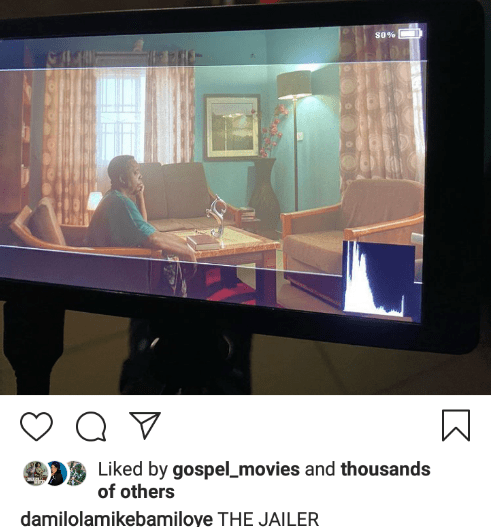
The story for Jailer was by Daddy Odesola while it was written for the screen and directed by Damilola Mike-Bamiloye. The job of director of photography was given to Joshua Mike-Bamiloye who did an awesome job in Abattoir, while I think Damilola Mike-Bamiloye shot a few scenes too judging from a courtroom BHS. Joba Adepoju who has been doing very well is the sound man. I think Tolulope Mike-Bamiloye is the script supervisor, although Tobi Olumuyiwa, who is the assistant director, is seen in a picture discussing some things on the script with Tomisin Fasola. In a group picture of the crew, I spotted Toluwa Olanrewaju, as well Emmanuela Mike-Bamiloye here in another behind-the -scenes picture.
THE PLOT
From the trailer, we get to know that Temilola was 9 years old when her dad was ambushed and shot. As a young adult, she’s bent on seeking revenge for the murder by accusing Baba Adegbola who was likely a member of the gang responsible for her dad’s death. She’s overtaken to get even so much that pleas by Adegbola’s son fall on deaf ears. In this quest for justice that is perhaps tinged with bitterness, will Temi find peace? Will Adegbola get physical freedom in addition to the spiritual change he seems to have experienced? Will Adegbola’s son develop some kind of friendship with the lady determined to let his father feel the full force of the law? We’ll see.
You’re welcome to the review of “High Calling Part 3”. It continues from where Part 2 concludes and it shows that Edward has chosen the path of obedience as he returns to the US, determined to serve God and stay with his family. Though he confesses that it has not been easy, he admits that Jenny is surprised by his return and that has humbled her a bit.
Edward back in the U.S.
A quick word about the music once again which sounded really good. The instrumentals were well-constructed and inserted at appropriate places. Along with the chants, the soundtrack of High Calling was really nice.
Rotimi Amodu as Eric Thompson
Now, from the off, it’s clear this part would mainly be about John getting a wife. Fiyinfolu CP Okedare was so original in his performance in this part, as he has been throughout this trilogy. His narrations are usually engaging and his excitement is so palpable. His portrayal of John in Part 3 is believable, especially his proposal, right to the way he handles the seeming rejection and the eventual acceptance; in fact, the looks on John’s face are priceless. I must also commend the acting of Rotimi Amodu as Eric Thompson – he does very well in the scenes he plays in. We don’t know what exactly is wrong with the church Eric used to attend but his statement that he does not need the respect of a man of God who failed to show him the way to heaven is pregnant with meaning. I see this as a call to all chosen as shepherds of God’s flock to show their sheep the way to eternal life, and not focus on frivolities.
One of those golden facial expressions
The character of Samson is one that should not be overlooked because from him, we perceive the importance of having godly friends who offer sound counsel. He tells John to ask Doctor Toluwanimi about her relationship with God. That lets us know how important this is because can you imagine someone who loves God with all his heart getting married to a person with whom they cannot share that love for God that is most important in their lives? When Doctor Toluwanimi responds, it’s quite clear that at the core of their beings, they would be in unity because their foundation is their relationships with God.
A friend that sticks closer than a brother
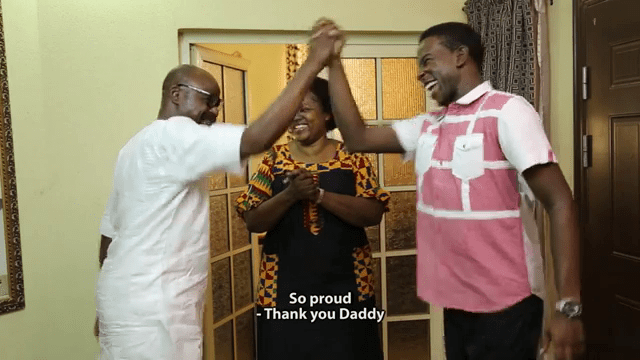
The pieces of John’s life start coming together as God establishes him. At the home front, John experiences a restored relationship with his dad. It’s a sharp contrast to what obtained in Part 1; now, John’s shame has been taken away and he has become honourable in Mr Johnson’s sight. It means the world to John when his father confesses that he is proud of him and that was a really touching moment for me.
So touching…
John is quite admirable. I observed that throughout this movie, he’s deeply respectful and quite embodies the scripture that says that we should trust God in all our ways and not lean on our own understanding. He’s very mindful of God – when he’s driving, he’s thanking God and praying to Him; when he’s on the hospital bed, he’s praying. He doesn’t allow anyone pressure him into making decisions; he politely says that he’ll pray about it. It’s no surprise then that he is loved and favoured by both his boss and his dad.
Mr and Mrs John Johnsonto-be
Later, John’s pastor lets him know that the arrival of Doctor Toluwanimi is a sign of greater things to come and indeed, John experiences an astonishing promotion in the same company he was forced out of in Part 1. I’d like to conclude this review with a statement made by Doctor Toluwanimi in her chat with John – that she loves her country and that she keeps praying that God will heal Nigeria as he is using Nigerians all over the world. That embodies what God expects of us in our respective nations – love for our country, prayers for healing; that’s one aspect, the faith aspect. The other side is the works aspect, the requirement of obedience. The bible says in Proverbs 29:2 (AMP) that when the righteous are in authority and become great, the people rejoice, but when the wicked man rules, the people groan and sigh. Easy-to-Read Version says the people complain. So, we should ensure we all play our parts in letting God’s kingdom come and letting His will be done on earth as it is in heaven.
Alright, we’ve come to the end of the review of the High Calling Part 3. Click below to watch the movie:
Next, we’ll be reviewing the Season 2 of “Kembe Isonu” from Femi Adebile. Till then, stay blessed.
You’re welcome to the review of “High Calling Part 2”.
Jenny, Edward and John
The timeline is sped up by a year and we see that the relationship between John and his brother has deteriorated because Edward is upset at John for refusing their dad’s offer. Not long after, Edward gets married to Jenny, played by Toyosi Babalola, whose performance was top notch. The accent was mostly believable and Edward realistically mimics her – that was really good acting and role interpretation.
Edward and John in a tête-à-tête
In “High Calling Part 2”, John further paints a picture of a man to whom God is everything, a man sold out to the gospel, and shouldn’t we all? He states clearly that every child of God is called to tell others about the good news. However, in the face of rejection by Edward, he begins to second-guess his obedience to God’s instructions and gets discouraged, but his pastor gives him some perspective by letting him see how much of a blessing God has made him for the brethren. He assures John that God owes no man and that he would be rewarded in due time.
The movie subtly shifts the focus of the narrative to Edward as the results of the path each brother has chosen begin to show. This shift makes me I believe that the Part or Episode format complements the nature of this story, because it enables us to get as much from the movie as we can.
Tables turning…
So, the tables start turning gradually when Mr Johnson falls sick and receives his healing through John. Edward, for whom everything seems to be going well, begins to reap a harvest of discord in his home. It is revealed that Edward has got his kind as a wife – a nominal Christian. My favourite line in Edward’s story is spoken by his mother: Did you contact God about Jenny? It was good to see them trying to get to the root of his marital problem and indeed, the truth comes out as Edward admits to having been impatient. He then sees that it is high time he took God seriously. I’m glad that John makes him see that though he is so willing to pray, obedience has its place too. I think the parallel between prayers and obedience is something that has come up frequently in my reviews. Eventually, Edward doesn’t just pray for his situation to change, but allows the prayers to change him, and we hear him ask God to restore him.
The Johnson family prays.
I commend the way the movie depicts John’s maturity over time in the film. We see his periods of passion, disappointment, seeking God, surety, persecution, joy, discouragement and continuing God’s work. I like the way the verse of the soundtrack we hadn’t previously heard is introduced in this scene towards the end as Jay-Mikee and his wife, Tolulope Mike-Bamiloye do a beautiful duet. For me, this set up the concluding part very nicely; Jay-Mikee revealed in a tweet that High Calling is a three-part story. This makes me guess what the focus of the third part would be and brings to my mind that like-for-like situation we talked about earlier. Going with that principle, we could confidently say that John too would get his kind – a lover and servant of God. I guess that this will be settled in Part 3. We’ll see.
I’m giving it to You…
Alright, we’ve come to the end of the review of “High Calling” Part 2. Have you seen it? What did you think about it? Please let me know in the comments section below.
Here’s the link to the movie:
Click below to watch the video of this review :
Next, we’ll be reviewing the concluding part of “High Calling”. Till then, stay blessed!
You’re welcome to the review of the first part of “High Calling” from The Mount Zion Film Productions. It was written and produced by Gloria Bamiloye. A nostalgic aspect of this production was the soundtrack which was a remake of Like a Tree from Jay-Mikee’s 2013 album A Living Sacrifice. This one was so much better and was accompanied by some really nice chants. The use of portraits in some settings in “High Calling” was to great aesthetic effect.
Father and first son
The acting in “High Calling” Part 1 was excellent. I love the way Fiyinfolu CP Okedare who plays John delivers his dialogue; very impressive. My favourite scene was where he and Kayode Owojori wonderfully portray the nature of the relationship between John and his father respectively.
Was John really too involved?
I also love the characterization in “High Calling” Part 1. John is a lover of God who has finished his undergraduate studies with a third class degree and his brother Edward, played by Damilola Mike-Bamiloye and his father point to what they perceive as John’s over-zealousness for church activities as the cause. I think this is a scenario that sometimes occurs in university campus fellowships. John however makes it clear that he studied his books and didn’t tempt God by being unserious. He doesn’t let the result get to him much though, as he believes that he is not defined by that result but by God’s high calling upon his life. In John, we find a man who sees and glorifies God in everything. Edward, on the other hand, is non-chalant towards his relationship with God; their father as well sees involvement in service to God in a church as “religious stuffs”. The film counters wrong notions of who a believer is; it corrects the stereotype about people actively involved in service to God being termed as pastors, thereby speaking against the spirit of religion that limits Christianity to the going around doing religious activities. John makes us see that it means rather, to have the spirit of Christ inside you.
Busy but not in the Father’s business
My take-away from this first part is the very thin line at surface value, in being a disciple of Jesus or just a nominal Christian. Edward and his father place reason OVER faith; to them, being a Christian is merely something fashionable on the outside, and so, dedication to God’s service doesn’t make too much meaning to them. Similarly, they regard secular activities much more than spiritual exercises and activities. We see Edward claiming to be so busy that he doesn’t have time for his relationship with God. A brother of mine once said that many Christians claim to be busy but are not in the Father’s business; I think this is true and calls for reflection on our parts.
Mr Johnson
Another thing for me is that we see the movie painted and driven by the plans that John’s and Edward’s dad has for them. I would say that Mr Johnson did have a beautiful plan for his sons, but it was a plan motivated by the fear of suffering and propelled by his harsh experience of life. However, nothing can be greater than the plans of the One who made us, who created us; His calling is higher than the troubles of this country. He calls us to something higher, something bigger than ourselves, even bigger than our natural abilities and talents. The Bible says that as far as the heavens are to the earth are His thoughts higher than our thoughts: God’s purpose for our lives is so grand that we cannot accomplish it in our own strength alone; we’d have to cry out to God to help us in accomplishing it.
“Holy Spirit, we can do this!”
That’s what happens in another scene that really gladdened my heart; the Holy Spirit tugged at John’s heart to tell his boss about the Good News that Jesus Christ saves. The first thing that flashed through my mind was that stage drama in “The Train” where an employee took steps to obey the Holy Spirit in a similar situation but ended up telling his boss about candles. John however, obeyed God and it turns out that all his boss needed to hear was the truth, and that set him, as well as his family, free from sin and bondage to the afflictions of the devil. He was only able to do this because He asked God to help Him.
I also observed that there is a need to really know what we are doing, to know when it’s time to pray and when it’s time to obey. For those who are yet to really commit themselves to God, when obedience is required, the usual response, like Edward gives, is “just be praying for us”.
Joy at God’s high calling
Towards the end of Part 1, we begin to see some results in John’s life and we see the importance of seeking God’s will. John has built the practice of doing this to the extent that he is even certain that God has a mission for Edward in the United States. That’s the reason I don’t believe that God “allowed” him to have that grade from the university because one, even if he had had a first class like his brother, he would have still told his father that he sensed that God had something for him to do in the country at that moment; two, despite his result, his father later decides to send him overseas and he still refuses. So, for one reason or the other, he finished with a third class result; what is sure nonetheless is that God used that less-than-desirable situation and still glorified Himself in it.
Alright, we’ve come to the end of the review of “High Calling” Part 1. Click below to watch it.
Next, we’ll be reviewing the “High Calling” Part 2. Till then, stay blessed!
You’re welcome to the review of “Couple of the Year”. It’s a 2020 movie released from the stables of Christoline Film Productions and was written by Kolade Segun-Okeowo.
Pictures in the setting like this one abound
As in “Welcome Yesterday”, the prominent use of pictures in the set design is laudable. The way the story is told is nice especially because layers of information unfold as the film goes on. The only issue with the production was the stray audios playing over the actual audio; I found out that using the subtitles helped me in following the story in spite of this.
Couple of the Year award
Couple of the Year is actually an award given in a church pastored by KSO’s character and the response of characters in the film as well as among the audience is mixed. The question remains: Should any couple be awarded Couple of the Year? The debate will continue but I think the motivation for the award is a good one, which is to celebrate couples seen to have shown sufficient proof that they’re worthy of emulation and declared as models for intending couples. The church also has an interesting though controversial policy of newly-weds spending a weekend after their honeymoon at a selected couple’s house, in this case the home of Deacon and Deaconess Farayola, who are seen as a model couple. I really like engaging stories with fictional realities like this which make them more interesting to watch.
Simultaneous sermons perfectly timed
The Farayolas, sadly, actually have no virtue in their marriage to be desired. They have been putting up appearances in church that they are in unity, while nothing could be farther from the truth. The couple, played by Adeoye Omoniyi and Sunmbo Segun-Okeowo, have themselves gotten used to the protocol – they have a ready-made kitchen routine and a sermon timed to perfection for new couples.
“Who chose us?“
Right after such mentees leave, the curtains of deceit are pulled off and we see the true state of the Farayola household. Even their daughter in boarding school dreads the thought of coming home which leaves us to only imagine how much of a warzone the home is. Boladale even tries to come clean and doesn’t want to keep living a lie but Adekanmbi is flat out hypocritical and prefers to hold on to the church title and respect he enjoys from people’s false perception of his home; he has the biblical knowledge of marriage but has refused to let it empower him to be a good husband. That made me see that the definition of a lie is anything we don’t see as God sees it.
Are you sure you know what you’re asking for?
The most interesting part of the movie for me was where the newly-weds in the movie, though debating the rightness of the award, go ahead to say that prayer youths of this age have been warned not to pray, or at least, to pray with understanding. So, really, unless you’re sure your model couple are truly godly people, don’t pray that your home will be exactly like someone else’s; just ask God to make your marriage the best it can be. Boladale herself says that she pities those using her marriage as a point of contact to pray.
Boladale is pushed to the wall.
So, Boladale is pushed to the wall and tries to commit suicide; that is when the façade ends and we see the dangers of deception during courtship. In a way, Deacon got his kind; he, a fornicator, wanted a virgin and he got someone who deceived him into believing she was one. They both engaged in one form of deceit or the other in courtship and reaped the harvest of strife in their home. Honesty in courtship is quintessential for really, only God knows the heart of a man, and so, it is important that we allow God to lead us to the right person.
Couple of All Time?
While the Pastor may have wrongly judged the true spiritual state of Deacon and Deaconess Farayola, I think he eventually shows himself as a good pastor. He’s a firm, principled man and calmly gets to the root of the matter in the Farayola household. He then leaves us with a tall but noble order for couples not just to be the couple of the year, but the couple of all time. To the glory of God, they make up and we see a new beginning for the Farayola family.
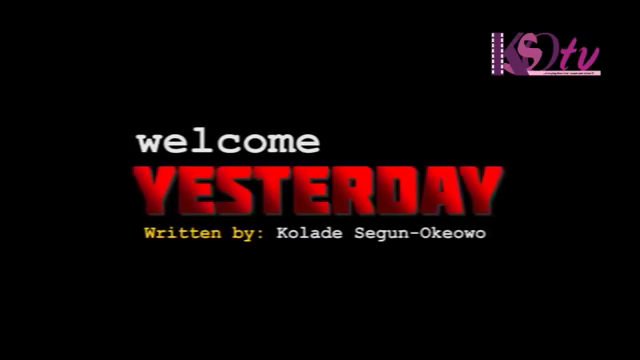
You’re welcome to a new set of gospel movie reviews and we’re kicking it off with “Welcome Yesterday” written by Kolade Segun-Okeowo (KSO). There are a couple of things I appreciate this movie for.
Who killed Bolatito?
First of all, “Welcome Yesterday” belongs to the Crime/Mystery genre, and it’s hard for me to recollect any gospel movie from that genre in recent times. If you do, please let me know in the comments section below. So, it was nice having a story in this field. It tells the story of the rape and resultant death of Bolatito, a 17-year old from the family of Laja Badoore, played by KSO himself. The movie goes straight to the point and from the first scene, we suspect that Laja knows something about the crime. We’re kept guessing down the line when the film shows us that there’s something fishy about Bolatito’s sisters, Ibukun and Bukola, and we don’t quite know how any one of them is responsible for the mishap.
Ajasa at Iya Kamo’s
Technically, this movie does well. I think the title is catchy; the cinematography was good and the establishing shots were particularly nice. The use of the dialogue of a subsequent scene while the current scene still had visuals was a creative scene transition. Also, though “Welcome Yesterday” is grim in tone, it manages to find some kind of comic relief in the predicament of Ajasa, who is wrongly accused of being an accomplice in the crime. The film also optimizes its runtime by skillfully avoiding the trap of repeating narrations which could easily make a story drag. The use of pictures in the Badoore house for the set design is commendable.
Curses aimed at the rapists
The concept of karma is explored when we watch a harrowing post-rape scene involving Laja as a teenager, and it seems the victim’s curses have come to manifest in his life. But then, Christ enters the picture and we see that of all the culprits that day, he’s the only one who seems affected by the imprecations. It shows us that everyone makes the choices that would determine the direction of their lives. Folorunsho repents of his misdeeds not long afterwards and becomes a child of God. The other members of the gang have also had their lives reshaped by Jesus and are serving God. However, I’d have loved to have heard Folorunsho say that he went to apologise to Hannah and sought her forgiveness after he’d repented because that’s an important step in genuine repentance; you make restitution, especially where possible. The movie makes it clear nonetheless, that new life in Christ won’t erase the scars but prevents your evil yesterday from affecting your bright tomorrow.
Goodbye yesterday or welcome yesterday?
Unfortunately, Laja has sunk deeper and deeper into sin and the depths he’s attained as revealed in the movie would make your ears tingle. It illustrates the evil in the heart of men; better still, the evil a heart without Christ would entertain and eventually execute. When we find out what Ibukun and Bukola have to do with Bolatito’s rape, we see the recurring fact as quoted by late Ravi Zacharias that sin will take you farther than you want to go, keep you longer than you want to stay, and cost you more than you want to pay. That’s exactly what we see in Laja’s and his daughters’ actions.
A time of reflection for the Badoore family
The bottom-line for Laja at the end of the day is that his family has created no room for God in their lives. We’d seen the spiritual and physical cause of the crime and previously, we’d only seen Bolatito’s pictures, but when we eventually get to see the crime that birthed the whole story, it’s much more heart-breaking.
A family in disarray
It’s a sad story and families do get torn apart in this way and other ways. As that hymn goes, may God grant us all Christian, godly homes.
Next, we’ll be reviewing another 2020 movie from Christoline Film Productions, “Couple of the Year”. Till then, stay blessed!